What actually is Agile?
Agile is a way of working that involves doing things bit by bit, whilst regularly looking at how you’re working, and adjusting accordingly if you can spot any potential opportunities for improvement.
That’s it in a nutshell. Simple, right? It’s not some dark art or some kind of management BS. It’s a very straightforward approach to doing things.
It is the opposite of making big detailed plans at the start of something, with a timeline of months or even years, and trying to get those plans done to the letter over a long period of time, without changing along the way.
The simplicity of Agile means that it can be applied in numerous different ways. It should adapt to be situationally specific and can therefore look very different in one workplace to another. Given that it should involve regular adjustments whenever you can spot an opportunity for improvement, it also means that once you start using Agile, it will continue to evolve in your workplace, as well as within you as you become more adept.
A Brief History
The Agile approach evolved mostly in software development, but it is very flexible and over the years has subsequently been applied to numerous types of work from IT to car manufacturing, fashion to supermarkets and even sushi restaurants and space exploration. People are innovating with Agile concepts and applying them to different projects, products and problems around the world.
Some people might still view Agile as a fad or buzzword, but it’s not a recent trend. Some of the earliest origins of Agile emerged around the time of WWII. It really started to establish itself during the 1990s and it’s been over 20 years since leading experts got together and codified its main elements.
So – Agile is here to stay.
The Agile Manifesto
Those leading experts I mentioned above who codified Agile over 20 years ago got together in what is now probably the most well-known skiing trip in the world of technology. They represented the best experience of innovative approaches to software development and wanted to form consensus on what works well in their line of work.
They came up with the Agile Manifesto.

These learned and innovative experts convened at a ski resort in Snowbird, Utah in February 2001. Here, they brainstormed what had worked well in their projects to try and work out if there were any common themes that they could identify and build upon. They subsequently came up with a robust set of guidelines on how to better develop software, documenting their agreed approaches and publishing it for the world to see. The Agile Manifesto was born, you can read it here, and as testament to its effective simplicity, it remains virtually unchanged over two decades later.
The website is a piece of internet history.

Look at its simplicity and layout, courtesy of original signatory (and inventor of the ‘wiki‘ concept): Ward Cunningham.
(Yes I pasted a link to a description of a wiki on wikipedia… how very meta).
The best way to understand it is simply to look at the site. It’s not very big and it’s very straightforward to understand, but I will relay the main information here.
The Agile Values
These are the Four Agile Values:
Individuals and interactions are more valuable than processes and tools.
Working software is more valuable than comprehensive documentation.
Customer collaboration is more valuable than contract negotiation.
Responding to change is more valuable than following a plan.
This is not to say that the things on the right are not valuable – indeed things like tools, planning and documentation can be extremely valuable. However, they are not as useful to a successful project as the items on the left.
Viewpoints of the Values
Let’s have a slightly deeper dive into what this all means.
Individuals and interactions are more valuable than processes and tools.
The first value should still be clear. A process might be effective, but if it slows down or stops working, you will never beat conversations. A machine might be really useful for getting something done, but not if it is at the expense of valuable discussions or collaboration.
Working software is more valuable than comprehensive documentation.
Working software is usually the goal of a technical project. Having it properly documented is often very useful, but all the time that it takes to write up all the features of a product would be better spent simply developing the product and making it better.
Customer collaboration is more valuable than contract negotiation.
Customer collaboration means that they are brought along on the journey. Their input on the process will give them better experiences, and also provide a team with good feedback to help keep them on the right track when they’re developing something. This in turn will result in happier customers, who will likely choose to continue paying for services rather than having to negotiate a price or using sales pitches to keep them on board.
Responding to change is more valuable than following a plan.
Finally, responding to change allows teams to adapt to market alterations, take advantage of new opportunities, or changes in customer demands while they are working. Planning is still really important. Indeed you will find planning happens regularly in Agile projects (every 1-4 weeks in a Scrum team for example), but the difference is that detailed planning is for the short-term, with longer-term planning kept a lot more light.
The Agile Principles
Okay so there’s more! The Agile Manifesto lists 12 principles which were agreed upon as being solid foundations for delivering good software.
You can see them on the original site here but I’ve copied them below for you as well:
- Our highest priority is to satisfy the customer through early and continuous delivery of valuable software.
- Welcome changing requirements, even late in development. Agile processes harness change for the customer’s competitive advantage.
- Deliver working software frequently, from a couple of weeks to a couple of months, with a preference to the shorter timescale.
- Business people and developers must work together daily throughout the project.
- Build projects around motivated individuals. Give them the environment and support they need, and trust them to get the job done.
- The most efficient and effective method of conveying information to and within a development team is face-to-face conversation.
- Working software is the primary measure of progress.
- Agile processes promote sustainable development. The sponsors, developers, and users should be able to maintain a constant pace indefinitely.
- Continuous attention to technical excellence and good design enhances agility.
- Simplicity–the art of maximizing the amount of work not done–is essential.
- The best architectures, requirements, and designs emerge from self-organizing teams.
- At regular intervals, the team reflects on how to become more effective, then tunes and adjusts its behavior accordingly.
Agile Frameworks
As well as the above guiding values and principles, a number of Agile frameworks and other ways of working have been developed. These can then be applied to different projects to add some structure to how things are done. They are usually lightweight structures so that they can be adapted to best suit the work and the team. These frameworks include:
- Scrum – a way of organising a small team (usually 10 or fewer people) into delivering pieces of work every 1-4 weeks; reviewing how the product and work are progressing and adjusting accordingly.
- Lean – an approach to working that encourages efficiency by visualising all the steps of the work and eliminating any part of these steps that constitute ‘waste’.
- Extreme Programming – a way of developing software that relies on frequent feedback loops to keep the work on the right track.
Application of the Values and Principles
Finally, the values and principles of the Agile manifesto are simple and straightforward. As such, people have been using them and applying them to all sorts of circumstances, projects and industries around the world, far beyond the software development it was originally set out for.
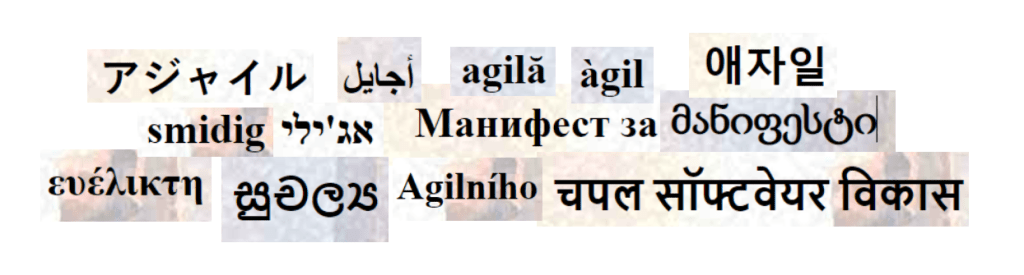
If anyone doubts that Agile ways of working are here to stay, just remember that the Agile manifesto has been translated into over 80 languages, and has been deployed with great success in all sorts of settings from Lego to SpaceX.
Ask yourself if you could use these values and approaches in your current workplace. Have you ever worked somewhere in the past which might have benefited from a more Agile approach?
Key concepts and further reading
There are plenty of hints, tips, tools and techniques that you can use to encourage an Agile mindset in a team. The Agile toolbox is large and ever-growing!



 PTSDelivery