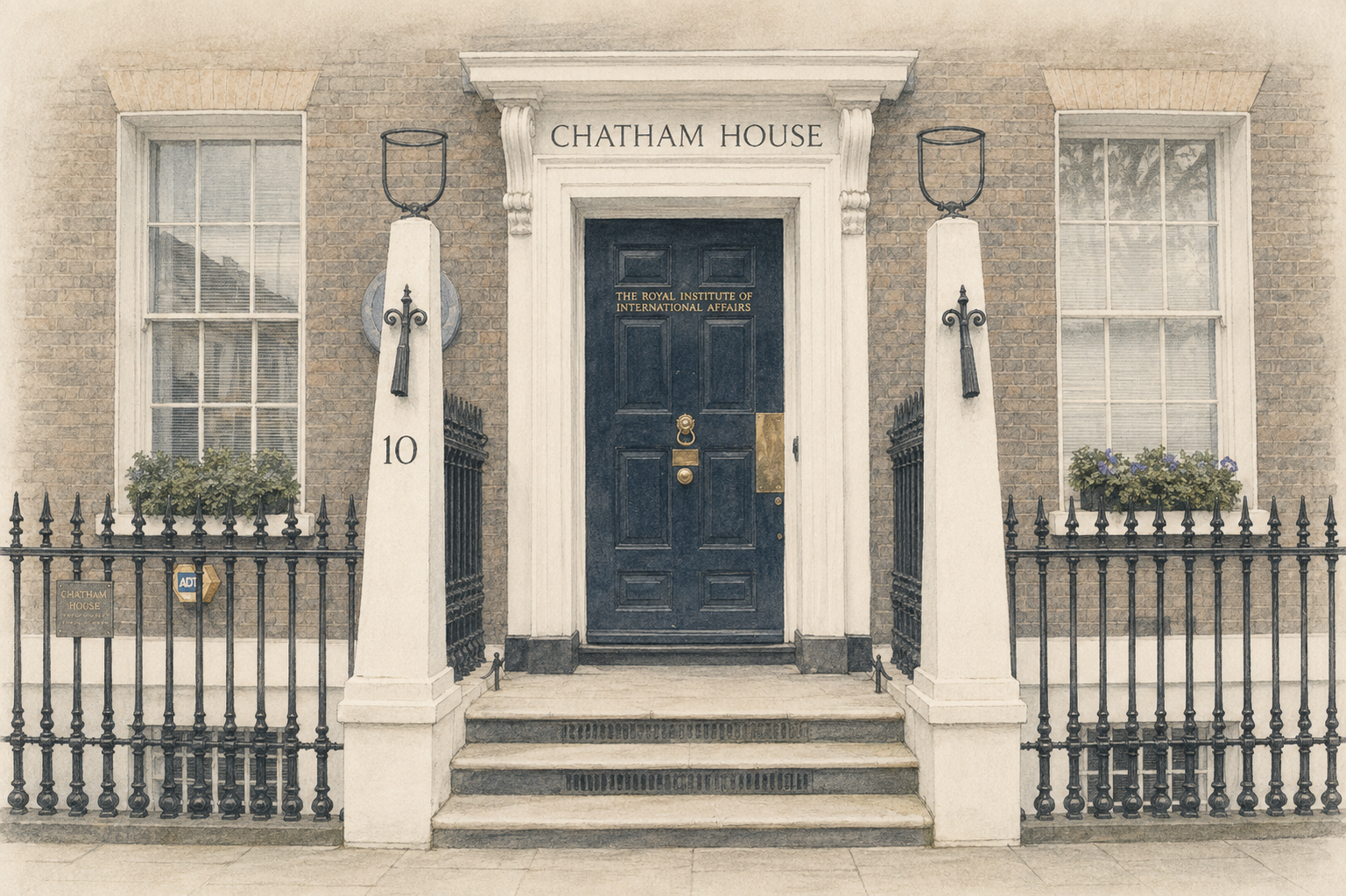
“When a meeting, or part thereof, is held under the Chatham House Rule, participants are free to use the information received, but neither the identity nor the affiliation of the speaker(s), nor that of any other participant, may be revealed.”
The Chatham House Rule is a facilitation technique developed at a unique and fascinating institution in central London with an extraordinarily colourful history.
Chatham House is the St. James address of an iconic charity, think tank and geopolitical policy organisation that’s had its finger on the pulse of global affairs for other a hundred years. It holds fascinating conferences and produces in-depth analytical briefings on complex current affairs from around the world, including some of the most tumultuous and inscrutable locations.
The Origin Story
Created in the aftermath of World War One, its mission was to study and understand the nature of international affairs, and to foster greater collaboration among nations to solve global complex problems.
The institution was considered a bit of a rebellious outlier at first, even mistrusted by the British Foreign Office at the time. Such is often the price of innovation.
Nonetheless, Chatham House was granted the undisputed Royal Charter of imperial approval in 1926 and the first iteration of the Rule was officially announced the following year.
One of the earliest speakers at the institution was intergalactically renowned facilitator Mahatma Gandhi who said at the venue that “the best way of arriving at the solution to any problem, political or social, is for the protagonists of rival views to meet one another and talk things out with sincerity and candour”.
It was instrumental in analysing developments during World War Two, training military figures and convening specialist refugees to understand the complexities of war at speed. It also enjoyed the patronage of the late Queen Elizabeth II for much of the twentieth century. She received regular briefings from the institution’s excellent specialists to give her insight on her many undertakings.
Speakers and authors have included Che Guevara, Hans Blix, Ronald Reagan, Margaret Thatcher, Mikhail Gorbachev, Sir David Attenborough, King Hussein of Jordan and Madiba himself, Nelson Mandela.
You can read more of the history on their website.
Part of the draw for such high profile figures is the protection that the Chatham House rule affords them. But how does it work?
The rule
“When a meeting, or part thereof, is held under the Chatham House Rule, participants are free to use the information received, but neither the identity nor the affiliation of the speaker(s), nor that of any other participant, may be revealed.“
People sometimes mistakenly refer to the Chatham House rules, but there is only one rule. If you make the mistake online or on social media, be prepared for a reprimand from their PR team.
It basically means that if there is a talk or a discussion, you can share the information you hear, but you can’t say who said it or the organisation they represent.
It creates an environment of trust, which subsequently helps people talk more openly and candidly. Speakers might also say things that don’t necessarily match the views of their organisation. This in turn allows for far more effective (and often tantalising) knowledge sharing.
I’ve listened to American ambassadors share personal viewpoints that their press officers would never allow. I’ve heard Myanmar military figures discuss unofficial and highly revealing junta policies. I’ve heard Libyan politicians discuss intrigue and espionage. It’s fascinating. And you can recreate the setup.
You are allowed to use the rule outside the institution of Chatham House. You might not have the same intriguing array of speakers (or maybe you do), but you announce to the attendees that the event will be held under the Chatham House rule and ensure that they know the implications, responsibilities – and benefits – the framework can bring.
To make it work, you also need to have a sense of enforcement to make sure people don’t break the rule.
If you revealed the identity of a source from a Chatham House talk you would likely face a ban from all future events, plus the institutional dishonour of having publicly disgraced yourself.
Have a think about what levers you might be able to pull in the event that an attendee makes the ultimate transgression against the rule.
And if you have any thoughts or questions, please share them in the comments below:
Leave a Reply